
Sora, Viggle, Dall-E: How AI platforms are taking over creative industries

Lucas Paulino
Here we are talking about music, film, and studio arts again, but this time: it's AI in the judgement chair. In this day and age, we are all familiar with or seen some form of AI use. Whether it’s a video of someone having a conversation with their Tesla’s personalized AI model, a compilation of AI bunnies jumping on trampolines, or even an AI cover of Eric Cartman singing “Locked Out of Heaven.” It is out there, and it is coming. But interestingly enough, it is the creative industries that are taking a hit with the development of newer, faster, and more realistic models. These models are also becoming easier to access and use.
I took to the app store to test out a couple of these platforms for myself, starting with Sora. This OpenAI product is a text-to-video model that creates short form (less than a minute) videos in response to a given prompt. The result was surprisingly realistic, and I immediately questioned whether I was tech-savvy as I thought with AI identification. Accustomed to seeing these Sora videos already appear across various social media platforms, I wondered how their popularity could blur the line between what is real, and fake. Soon after Sora’s release, it sparked concern across Hollywood. Filmmaker Tyler Perry even paused an $800 million studio expansion after seeing how powerful the technology was, saying it could “touch every corner” of the film industry. Already, it is showing potential uses, in turning physical backdrops into simulated remote sets, potentially replacing human acting roles, and dislocating the tasks of entire crews involved in the creative process. As impressive as that might be, I can’t pretend it doesn’t feel like a threat to the human aspect of filmmaking.
For the more experienced users, whose motives perhaps fall on the comical side, the text-to-animation platform Viggle AI has made a name for itself in the world of memes and humor, where users are given the opportunity to create videos by animating static images using text prompts or motion templates. On TikTok and Instagram for example, users often use Viggle to animate cartoon or anime characters, and other celebrities performing trending dances, raps, or lip-syncs, which leads to widespread participation and creative remixes. Back in April of 2024, a video of rap artist Lil Yachty walking out on stage in one of his concerts had been replaced with the figures of JP Morgan Chase CEO Jamie Dimon, former Knicks coach Tom Thibodeau, and most famously, the Joker. While to the viewer, Viggle AI appears significantly less developed and easier to distinguish as AI than other platforms, its lack of flawless video production does not diminish the value of this accessible and free-to-make content. In fact, I would argue that Viggle’s rough edges are part of what makes it so entertaining. For example, the speed and versatility of Viggle AI makes it a content farm for social media accounts willing to put in a bit of time to write prompts and reap the benefits. Besides, considering the way algorithms work today, anything can go viral, and from personal viewing experience, a funny AI video can have just as many likes, if not more, than a “real” one.
Finally, Dall-E, another OpenAI model that has been around for a bit longer than the others, allows users to generate images from text prompts, or edit existing images by using AI expansion and filling in tools. Creatively, it has been used for making album covers, to help designers visualize concepts, create custom graphics, or take on product design. However, I asked Dall-E several prompts, and in its response, I identified some flaws. Firstly, it lacks the ability to produce accurate text that is spelled correctly, or that resembles any words at all, due to its inability to understand language. When I prompted it to create a movie poster for neo-noir set in New York City titled “Le Chauffer,” with the text as the centerpiece and focus of the poster, what I received was more along the lines of simply “caųƒfʀɾɽ” hidden on a signpost in the left hand corner. At least it got the signpost right. What I found the most interesting, however, was what happened when I asked it for something different. Neuroscientist and author David Eagleman, PhD suggests that what Dall-E cannot do is just as important as what it can. “That is,” he states, “it has no way to filter what is good, let alone what is profound or beautiful.”
And so, I asked Dall-E just that: [create a painting that is "good." one that is profound, and beautiful.] This was the result:
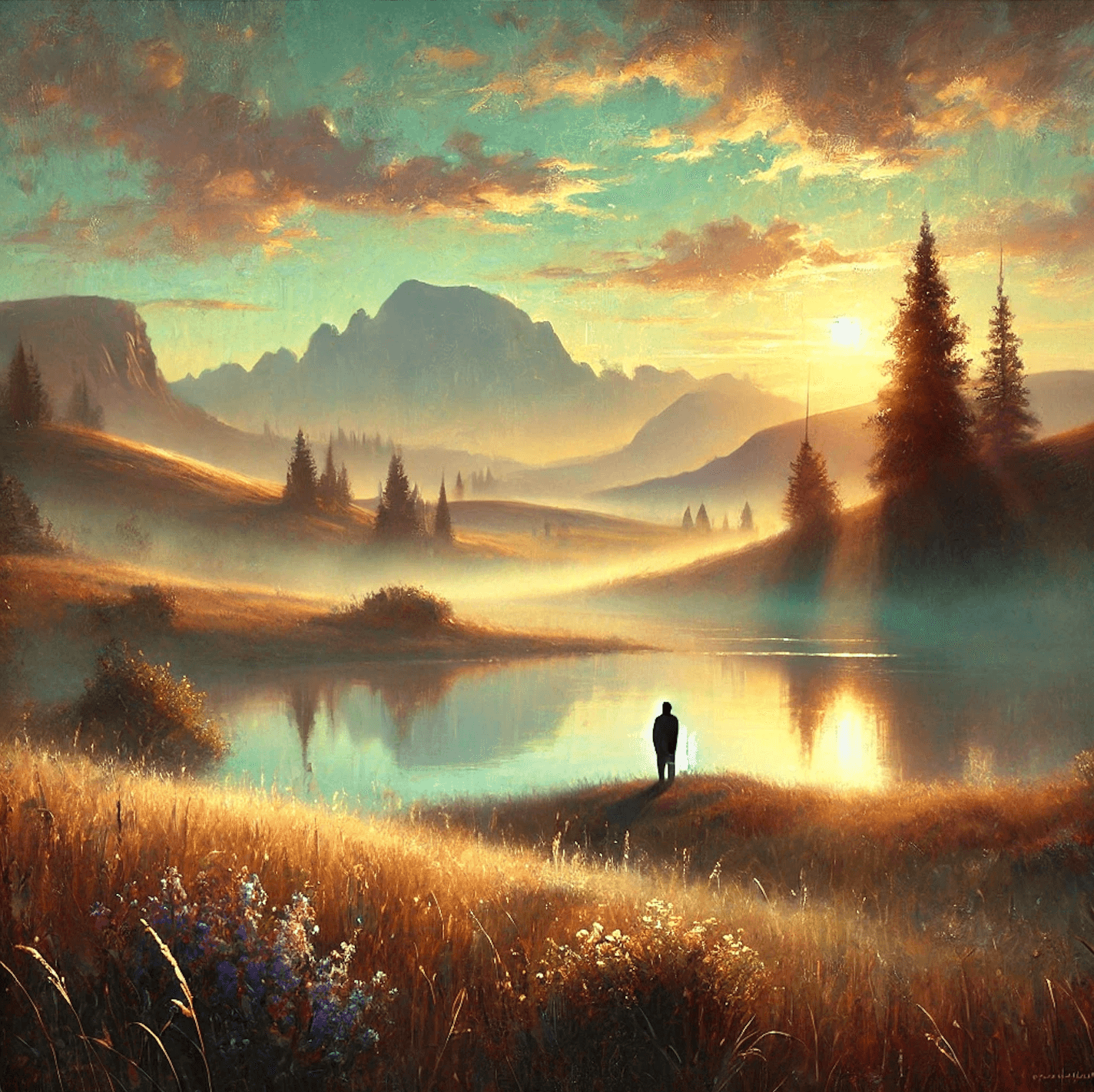
Dall-E
Now, even though I am not a painter, I believe most people (including myself) who set their eyes on this without knowing it was made on a computer would think it’s at least visually pleasing; good so to speak. However, AI is getting scarily accurate, especially in the creative industries, and over time, it is haunting to think about how much knowledge and ability platforms like these will have.
I asked Dall-E to create (to the best of its ability) replicas of Van Gogh’s “Starry Night” and Diego Velázquez’s oil painting, “Las Meninas,” and the results were surprisingly, and scarily, accurate. Down to the stroke. Which led me to consider how copyright and monetization will play a role in this rise of AI. More importantly, are the videos I'm watching, the music I listen to, or the art that I am viewing AI generated? These are questions that we have to worry about now.
Lastly, AI is showing up in the music industry in various ways, with the platform “Suno” among the most popular. AI artist “Xania Monet,” managed and created by Telisha Jones made its No. 1 debut on the R&B Digital Song Sales chart on Sept. 20 and a No. 20 start on the multimetric Hot R&B Songs chart a week later. But who is listening to this music? Enough people to allow her five-song catalog to generate an estimated $52,000 in revenue to date. But there is certainly a scale when it comes to the extent to which artificially intelligent software is used in music. For example, the technique of beatmatching or auto-matching tempo is still widely used by DJs to blend musical tracks, or create transitions. But when the musical tracks themselves are AI generated, that is a whole other extreme. Does that mean that all music that has some form of computer generated software behind its production should be outlawed? Well, that is up for discussion, but there are definitely supporters and opposers for every form of AI use in today’s creative world.
Still, there is no doubt that music, film, and all art will continue to have a human quality to them. AI art lacks the imperfections, and there has yet to be a song where it puts heart and soul into the process of creation. As someone who devours music 24/7, I could still make out these inconsistencies and the unnatural craft of the art these platforms are presenting, and I'm sure many Spotify Lossless listeners, film enthusiasts and gallerygoers out there can too. At the end of the day, artificial intelligence is not leaving, only getting more advanced and emerging in every crevice of every industry, but it is the consciousness of human art and the emotion that is produced that will truly, hopefully, never disappear.
make sure you follow the format outline linked in schoology!