How many things are you able to achieve in eight minutes?
Maybe you would be able to make toast, or get to the train station. Somehow, four people were able to make the “Heist of the Century” in one of the most famous museums – and managed to get away with it. The heist in question is one that robbed The Louvre, the most visited museum in the world, of 100 million US dollars.
But how did it happen? Let’s go over the timeline that led up to the heist:
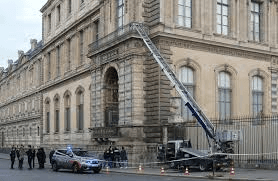
On October 19th, at 9:30 A.M., the thieves parked a truck under the windows of the Apollo gallery, which has a historic collection of crown jewels. The truck, used for moving furniture, had a ladder in the back, a common sight in Paris. This somewhat odd image seemed unsuspicious since two of the thieves were dressed up as construction workers, there for "maintenance".
Once at the windows, the thieves used disc cutters to break into the museum. This triggered the security alarm. The thieves then used their disc cutters as weapons, threatening the guards and getting the staff and tourists to evacuate. With them gone, the thieves stole eight items, three of them belonging to Empress Eugénie: one sapphire set of earrings, a tiara, a necklace, and part of Napoleon's emerald wedding set.
By 9:38 A.M., the thieves had already taken off on electric scooters, with 100 million dollars worth of jewelry. Eventually at 10:34, the theft was publicly announced, which shook France’s morale when the mood was already very low. Thankfully, during their rush from the scene, the thieves dropped Empress Eugénie’s crown, damaging it, but leaving it behind.
On October 22nd, investigators finally found DNA at the crime scene and on October 24th, 150 fingerprint evidence were sampled.
On October 25th and 26th, two suspects were arrested. One was arrested at the Paris Charles de Gaulle Airport at 10 P.M. trying to go to Algeria, while another was about to go to Mali. After spending 96 hours in custody, both of them “partially admitted” that they were part of the crime.
By October 30th, the police had made five more arrests linked to the heist in coordinated raids across Paris. One of the suspects was identified through DNA traces, although the police still don’t know if they had direct involvement. Paris prosecutor Laure Beccuau felt like the police might be able to get more information about the heist, especially after phones and other objects were found on the suspects that had encrypted messages.
Now, some may be wondering what the motive was or why just jewelry? Experts assume that the thieves were truly after the jewelry because it is the easiest to transfer and use. Unlike paintings, emeralds can be returned back to their original state and gold can be melted down. Therefore, this heist was more of a “commodity theft” (commodity means an item that can be sold) according to Vernon Rapley, a former leader of the London police squad. This heist ultimately made people wonder about how the Louvre could’ve been better protected, though labor unions mentioned that there were staffing and technical issues, especially among security. Currently, the police have not discovered where the jewels are and they worry that the thieves might “reshape” the jewels, destroying centuries of history.
But this wasn’t the first time there was a major heist at a major museum. For example, in 1994 at the National Museum, Oslo, two burglars climbed a ladder and broke a window. And in one minute, they were able to steal the famous “The Scream” and left a note saying, “A thousand thanks for your poor security”. This theft is quite similar to the Louvre heist, from the breaking in through the window to the failure of security
Also, in 2000 at the Ashmolean Museum, Oxford, the thief did a kind of spy sequence where they dropped through the skylight and filled the gallery with smoke, leaving with Cézanne's “View of Auvers-sur-Oise”.
What I’m trying to imply here is that this has happened before, so there is a slight hope that the artifacts may be recovered and returned to their home, the Louvre Museum. Additionally, this case is an active investigation so things may change over time. Maybe in a few weeks, the jewels will be found. Only time can tell.